


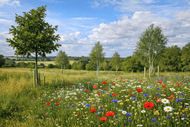
The Benefits of Combining Tree Planting and Wildflowers on Your Land
For landowners and farmers, managing a productive yet environmentally friendly landscape is a balancing act. One of the most effective ways to achieve this is by combining tree planting with wildflower meadows. While each has its individual benefits, together they create a powerful synergy that boosts biodiversity, improves soil health, and enhances the visual and ecological value of your land.
Why Plant Trees on Your Land?
Trees are more than just a long-term investment. They provide shade, shelter, and food for wildlife, and play a critical role in soil conservation and water management. Deep roots stabilize soil, reduce erosion, and improve water infiltration. Certain species also fix nitrogen, enriching the soil naturally, which can benefit nearby crops or pasture.
Additionally, trees act as windbreaks, reducing wind erosion and protecting crops and livestock. For landowners interested in carbon farming, trees also capture carbon dioxide from the atmosphere, contributing to climate mitigation efforts.
The Role of Wildflowers
Wildflower meadows are not just beautiful—they are ecological powerhouses. They support pollinators like bees and butterflies, provide habitats for birds and small mammals, and improve soil health with their diverse root structures. Wildflowers can also act as natural pest control, attracting beneficial insects that prey on crop pests.
For farmers, wildflower strips along fields or around trees can increase pollination, boost crop yields, and enhance the overall sustainability of the land.
The Synergy: Trees and Wildflowers Together
When trees and wildflowers are combined, the benefits multiply. Wildflowers around newly planted trees help protect young saplings from weeds and soil erosion, while improving soil structure and fertility. The trees provide partial shade, which can benefit certain wildflower species, particularly in hot climates.
From an ecological standpoint, a mixed landscape of trees and wildflowers supports greater biodiversity than either alone. Birds, bees, and small mammals thrive in these habitats, creating a more resilient ecosystem that can naturally support your farm’s productivity.
Practical Tips for Combining Trees and Wildflowers
-
Plan Your Layout: Avoid planting trees too densely. Leave enough space for wildflowers to grow and thrive.
-
Choose Compatible Species: Select tree and wildflower species suited to your soil type, climate, and farm goals. Native species are usually the best choice.
-
Use Protective Measures: Young trees may need guards or mulching to protect from grazing animals. Wildflower areas can act as a natural buffer.
-
Consider Maintenance: Wildflowers require minimal mowing, but periodic cutting after seed set ensures long-term health and diversity.
-
Observe and Adapt: Monitor growth and adjust planting patterns as your trees and wildflowers mature. Over time, the balance between sunlight, shade, and ground cover will evolve.
Combining tree planting and wildflowers is a cost-effective and environmentally rewarding strategy for landowners and farmers. Not only does it improve soil health and biodiversity, but it also enhances the beauty and productivity of your land. With thoughtful planning and maintenance, these two elements can create a thriving, sustainable landscape that benefits both nature and your bottom line.
FAQ: Tree Planting and Wildflowers
Q1: Can wildflowers grow under trees?
A: Yes! Many wildflower species tolerate partial shade and can thrive under young or mature trees. Choose species suited to your soil and climate.
Q2: How close should I plant trees to wildflower areas?
A: Leave enough space for sunlight to reach the wildflowers. Typically, 3–5 meters around each tree is sufficient, depending on tree size and species.
Q3: Will trees compete with wildflowers for nutrients?
A: Initially, some competition occurs, but many wildflowers have shallow roots while trees have deeper roots. Selecting complementary species can minimize competition.
Q4: What maintenance do combined areas need?
A: Minimal maintenance is needed. Protect young trees, mow wildflowers after seeding if necessary, and monitor for invasive weeds.
Q5: Which tree species work best with wildflowers?
A: Native species like oak, birch, and rowan often work well. Avoid dense conifers that block too much sunlight unless you plan shade-tolerant wildflowers.
Q6: How does this combination benefit my farm?
A: It increases biodiversity, improves soil health, attracts pollinators, provides habitat for wildlife, and can even improve crop yields.